 AETHERIUM
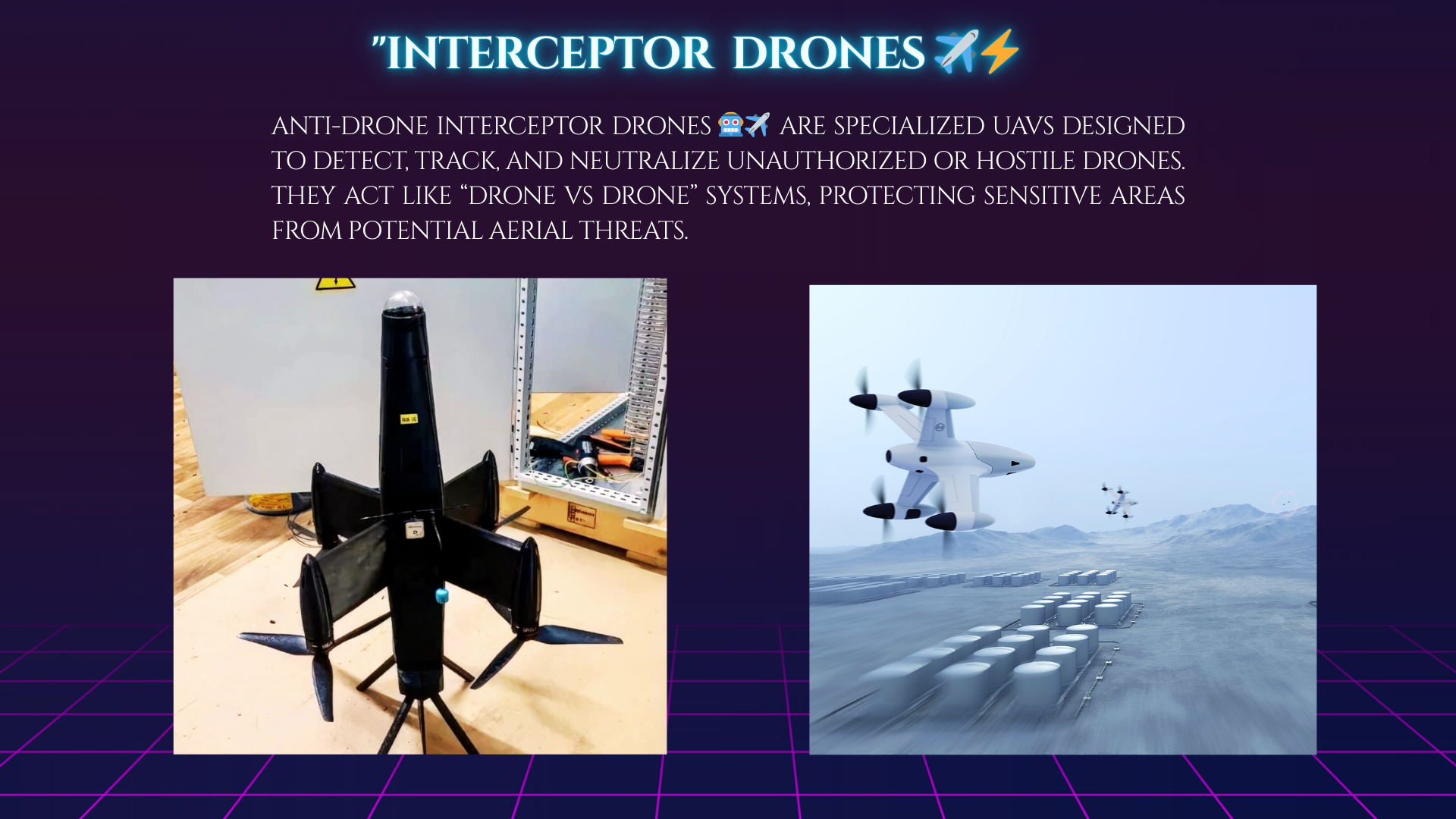
Anti-Drone Interceptor Drones 🤖✈️: Protecting the Skies from Unmanned Threats
With the rise of drones in both civilian and military spaces, unauthorized or hostile UAVs have become a serious security concern. Anti-drone interceptor drones are advanced systems designed to detect, track, and neutralize these threats, ensuring sensitive areas remain safe from aerial intrusions.
What Are Anti-Drone Interceptor Drones?
Anti-drone interceptors are specialized UAVs or systems that act like “drone vs drone” defenders. They autonomously or semi-autonomously detect and eliminate unauthorized drones using a combination of AI, sensors, jamming technology, and physical interception methods.
These drones are widely used in military operations, airports, VIP security, and critical infrastructure protection.
How Do They Work?
1. Detection 👀
Radar, RF sensors, optical and thermal cameras detect intruding drones
AI algorithms distinguish between threat drones, birds, or civilian UAVs
2. Tracking 🧠
Real-time monitoring predicts the trajectory of high-speed drones
Ensures precise interception
3. Neutralization ⚔️
Net Capture 🪢: Interceptor drone traps the target in mid-air
Collision / Kinetic Attack 💥: Physically disables or destroys the drone
Signal Jamming 📡: Disrupts GPS or communication to force landing
Role of AI in Anti-Drone Interceptors
AI is the brain of modern interceptor drones, enabling:
Smart detection & identification of drones
Predictive tracking for high-speed or evasive targets
Autonomous decision-making for interception method
Coordination of multiple interceptors in complex airspace
Without AI, intercepting fast or swarm drones would be nearly impossible.
Advantages
Fast response ⚡ to aerial threats
Targeted neutralization 🎯 reduces collateral damage
Automated operations 🤖 reduce human risk
Scalable solutions 🔄 can protect wide areas with multiple interceptors
Challenges
High-speed or small drones are difficult to intercept 🚀
Jamming-resistant or encrypted drones may bypass systems 🔐
Advanced interceptor systems are costly to deploy and maintain 💰
Legal and ethical concerns for urban or civilian airspace ⚖️
Examples of Anti-Drone Interceptor Systems
Yolka Interceptor Drone – Physically captures hostile UAVs mid-air
DroneShield Systems – Combines detection, jamming, and AI threat analysis
Airbus Counter-UAV Solutions – Integrates radar, cameras, and AI for autonomous drone defense
Conclusion
Anti-Drone Interceptor Drones 🤖✈️ are at the forefront of modern aerial defense technology. By combining AI, advanced sensors, and interception methods, these systems detect, track, and neutralize threats autonomously, ensuring the safety of sensitive airspace, critical infrastructure, and personnel.