 AETHERIUM
What is Advanced Battery Technology?
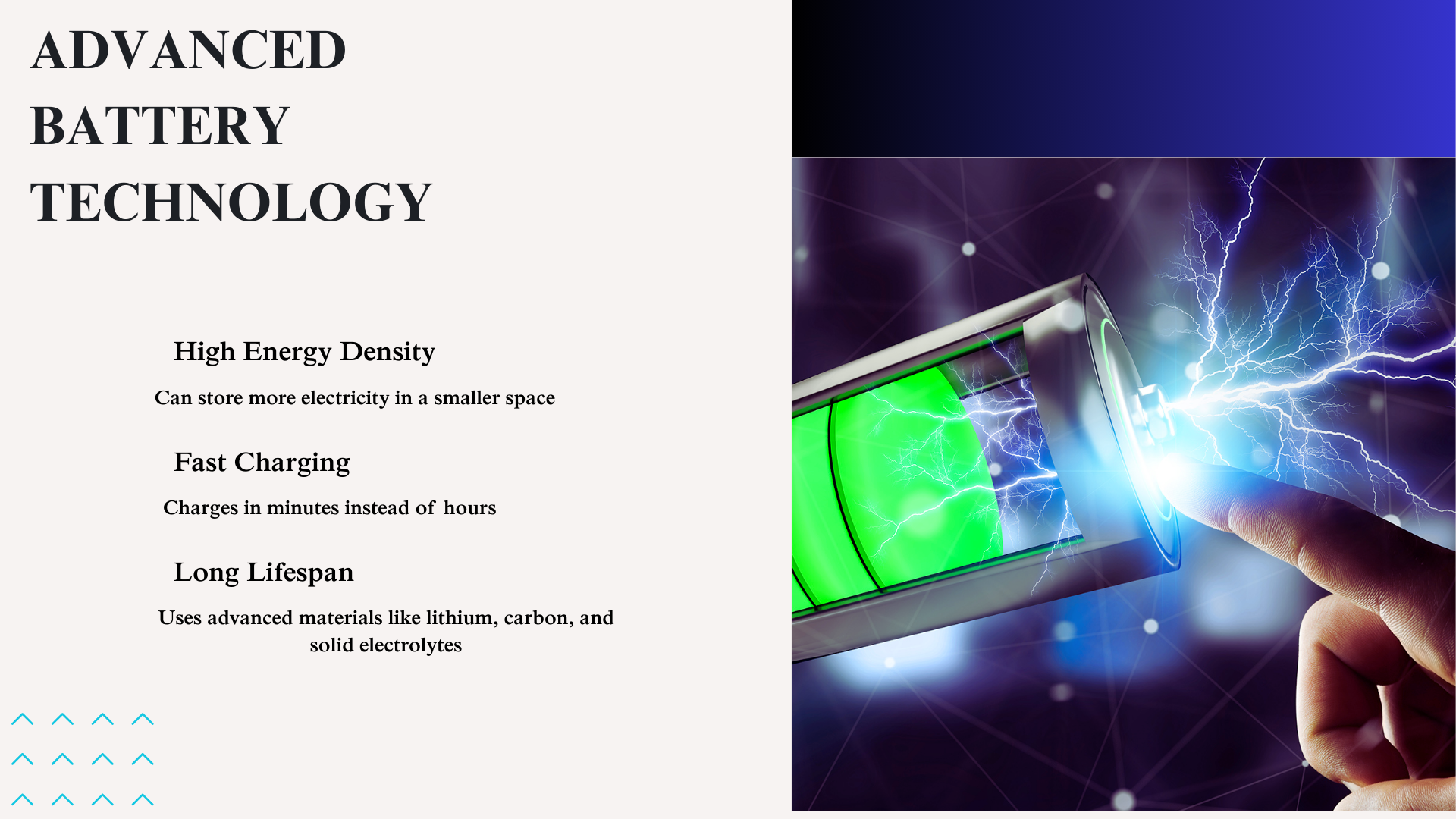
Advanced battery technology refers to modern energy storage systems that outperform traditional batteries in terms of energy density, charging speed, lifespan, and safety. Unlike conventional lead-acid or basic lithium-ion batteries, advanced batteries use cutting-edge materials, better chemical compositions, and intelligent management systems to meet the demands of modern electronics and energy systems.
Key Features:
High Energy Density ⚡ – More energy in a smaller size.
Fast Charging ⏱️ – Reduced charging time for EVs and devices.
Long Lifespan 🔄 – Can endure thousands of charge/discharge cycles.
Safety 🔒 – Reduced risk of overheating and short circuits.
Eco-Friendly ♻️ – Use of sustainable materials and recyclability.
Types of Advanced Batteries
1. Lithium-Ion (Li-ion) Batteries 🔋
Widely used in EVs, laptops, and smartphones.
High energy density and reliable performance.
2. Solid-State Batteries ⚡
Use solid electrolytes instead of liquid, enhancing safety and energy density.
Promising technology for next-generation EVs.
3. Flow Batteries 💧
Suitable for large-scale renewable energy storage.
Can store energy for hours to balance grid fluctuations.
4. Lithium-Sulfur & Lithium-Air Batteries 🌟
Next-gen batteries with ultra-high energy density.
Potential to outperform conventional lithium-ion in EV range and storage.
5. Supercapacitors ⚡🔋
Store energy quickly and deliver high power bursts.
Used in regenerative braking systems and backup energy solutions
How Advanced Batteries Work
Electrochemical Reactions ⚗️
Energy is stored and released through chemical reactions between the electrodes and electrolytes.
Battery Management Systems (BMS) 🧠
Monitors battery health, temperature, charge/discharge rate.
Optimizes performance and prolongs lifespan.
AI Integration 🤖
AI predicts battery degradation, optimizes charging, and improves energy efficiency.
Applications
1. Electric Vehicles (EVs) 🚗
Provides high energy and long-range performance.
Fast charging enables convenient use for daily commuting.
2. Renewable Energy Storage ☀️💨
Stores solar and wind energy for use when generation is low.
Supports smart grids and sustainable energy adoption.
3. Consumer Electronics 📱💻
Powers smartphones, laptops, tablets, and wearables efficiently.
Reduces weight and increases battery life for portable devices.
4. Industrial & Grid Applications 🏭⚡
Backup power for data centers, hospitals, and factories.
Enables peak-shaving and grid stabilization
Advantages of Advanced Battery Technology
High Efficiency ⚡ – Less energy wasted during charging/discharging.
Faster Charging ⏱️ – EVs and devices charge quicker than traditional batteries.
Longer Lifespan 🔄 – Supports thousands of cycles without significant degradation.
Safety 🔒 – Solid electrolytes and smart BMS reduce risk of fire or explosion.
Sustainability ♻️ – Recyclable and environmentally friendly designs.
Future Trends
Solid-State & Lithium-Air Batteries ⚡ – Higher energy density and safety.
AI-Optimized Battery Systems 🤖 – Smarter energy management and predictive maintenance.
Sustainable Materials ♻️ – Use of recyclable and eco-friendly battery components.
Integration with IoT & Smart Grids 🌐 – Optimizing energy storage for cities and homes.
Faster Charging & Longer Life ⏱️🔋 – Next-gen chemistry enabling hours of EV range in minutes.