 AETHERIUM
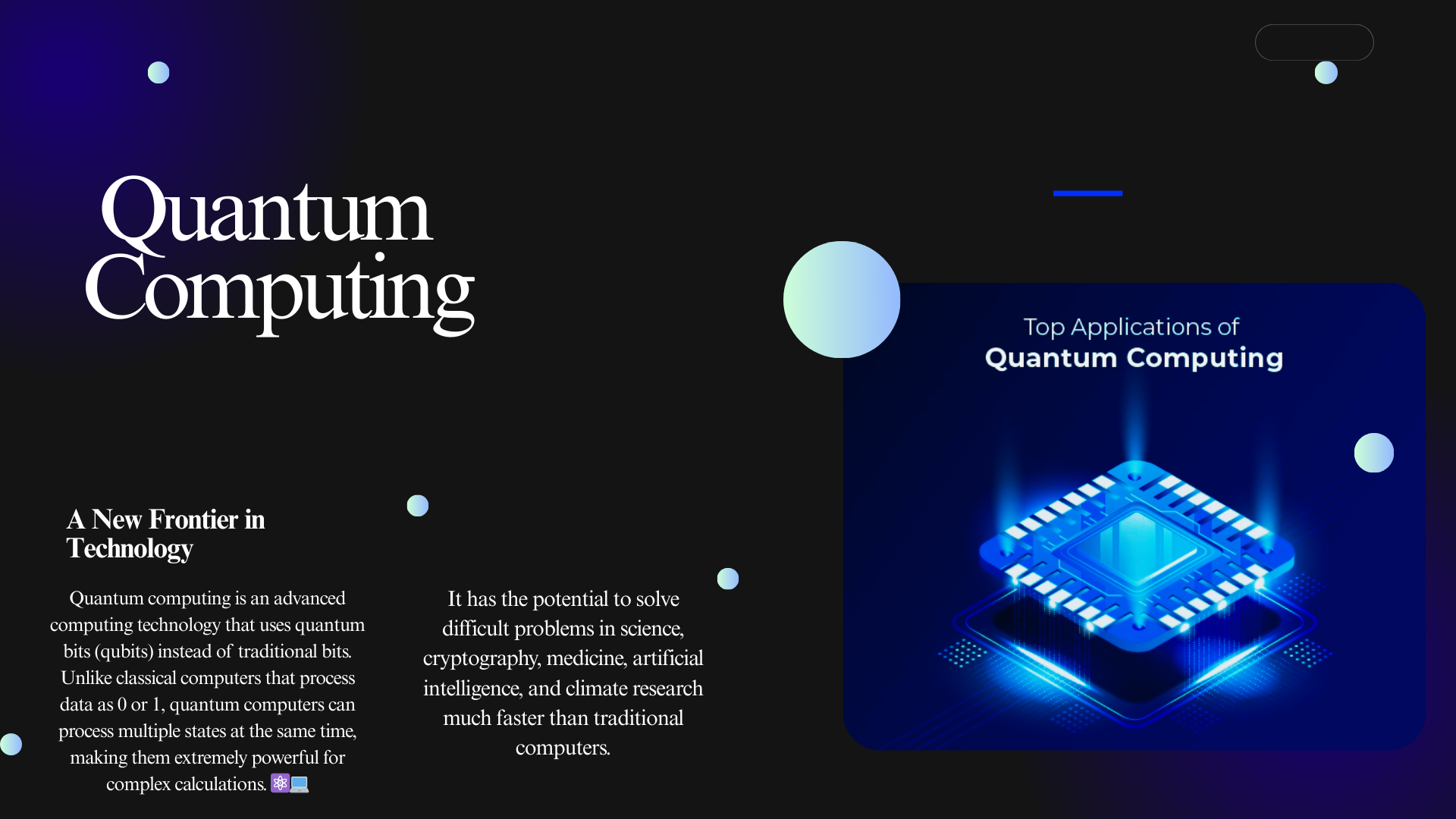
Quantum Computing: The Next Revolution in Technology ⚛️💻
Technology is evolving rapidly, and quantum computing is considered one of the most powerful innovations of the future. Unlike traditional computers that process information in a linear way, quantum computers use the principles of quantum mechanics to perform extremely complex calculations much faster. This technology has the potential to transform industries such as healthcare, finance, artificial intelligence, and cybersecurity.
What is Quantum Computing?
Quantum computing is a type of computing that uses the principles of quantum physics to process information. Traditional computers use bits to store data, where each bit can be either 0 or 1.
However, quantum computers use qubits (quantum bits). Qubits can exist in multiple states at the same time, meaning they can represent 0 and 1 simultaneously. This property allows quantum computers to perform many calculations at once, making them significantly more powerful than classical computers for certain tasks.
How Quantum Computing Works
Quantum computing is based on several key principles of quantum mechanics:
1. Superposition
Superposition allows a qubit to exist in multiple states at the same time. While a classical bit is either 0 or 1, a qubit can be 0, 1, or both simultaneously. This enables quantum computers to process large amounts of information at once.
2. Entanglement
Entanglement occurs when two or more qubits become connected. When the state of one qubit changes, the state of the other qubit changes instantly, even if they are far apart. This property helps quantum computers perform complex computations efficiently.
3. Quantum Interference
Quantum interference helps quantum computers find the correct solutions by amplifying the right results and canceling out incorrect ones.
Benefits of Quantum Computing
Extremely fast calculations for complex problems
Ability to process massive datasets efficiently
Helps solve problems that are impossible for classical computers
Supports innovation in science, healthcare, and technology
Challenges of Quantum Computing
Despite its potential, quantum computing still faces several challenges:
High cost of development
Difficulty maintaining stable qubits
Complex hardware requirements
Limited practical quantum computers currently available
Future of Quantum Computing
The future of quantum computing is promising. As research and development continue, quantum computers are expected to become more powerful and reliable. They may eventually solve some of the world’s most difficult scientific and technological problems.
Many technology companies and research institutions are investing heavily in this field, including IBM, Google, and Microsoft, which are developing advanced quantum computing systems.