 AETHERIUM
Space Technology: Exploring the Final Frontier 🚀🌌
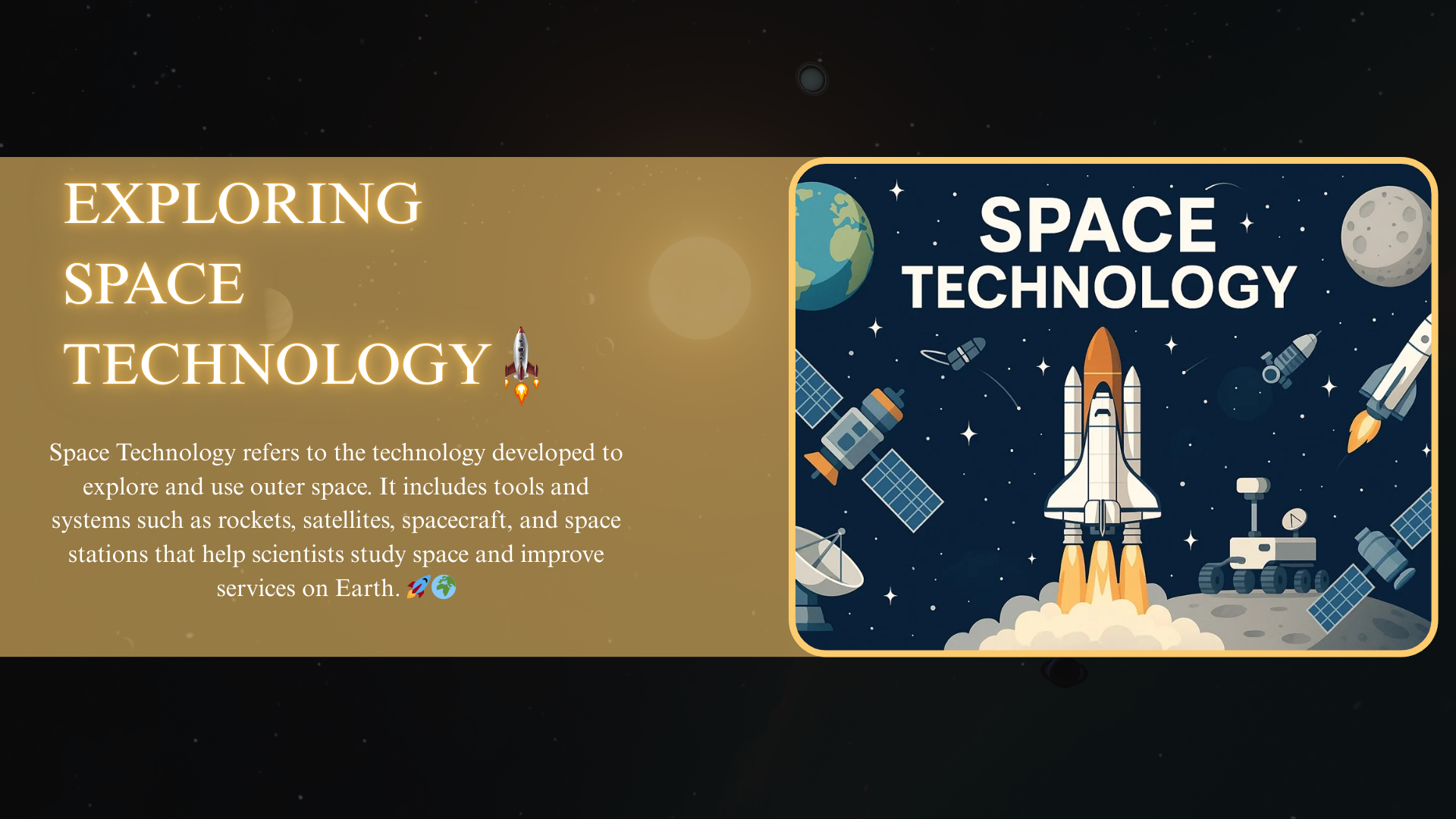
Space Technology is the branch of science and engineering that deals with developing tools, vehicles, and systems to explore space and use it for practical applications. This includes rockets, satellites, spacecraft, and space stations. Space technology helps scientists study planets, stars, and galaxies while also providing important services on Earth, such as communication, navigation, and weather forecasting
Key Components of Space Technology
1. Rockets
Rocket is a vehicle that propels satellites and spacecraft into space. Rockets use powerful engines to overcome Earth’s gravity and carry payloads into orbit.
2. Satellites
Satellite orbit the Earth and perform various functions such as:
Communication (TV, internet, radio)
Navigation (GPS systems)
Weather monitoring and climate research
Earth observation for mapping and disaster management
3. Spacecraft
Spacecraft carries humans or scientific instruments into space. Spacecraft explore planets, moons, and other celestial objects.
4. Space Stations
Space Station are orbiting structures where astronauts live and perform experiments. They help in long-term research about microgravity and space conditions.
Uses of Space Technology
Communication: Satellites enable global TV, internet, and mobile networks.
Weather Forecasting: Satellites monitor storms, cyclones, and climate changes.
Navigation: GPS satellites help in accurate location tracking for vehicles, ships, and airplanes.
Disaster Management: Space technology detects natural disasters like floods, earthquakes, and forest fires.
Scientific Research: Exploration of planets, stars, and galaxies increases our understanding of the universe.
Leading Space Agencies
Several organizations worldwide work on space technology:
Indian Space Research Organisation (ISRO) – India’s space research and satellite launching agency.
NASA – USA’s leading space agency involved in exploration and research.
European Space Agency (ESA) – Europe’s space research and technology organization.
Advantages of Space Technology
✅ Enables global communication and connectivity
✅ Helps predict and manage natural disasters
✅ Improves navigation and transportation systems
✅ Provides scientific insights into the universe
Challenges
⚠️ Space missions are expensive and require advanced engineering
⚠️ Space debris poses a safety risk
⚠️ Technical failures or accidents can occur
⚠️ International regulations and space law must be followed
Future of Space Technology
The future of space technology looks promising with innovations like reusable rockets, space tourism, deep-space exploration, and advanced satellite systems. As technology improves, space exploration will become more cost-effective, sustainable, and accessible, allowing humans to study the universe more efficiently. 🌌✨