 AETHERIUM
🐦 Drone Swarms: The Future of Coordinated Aerial Intelligence 🚁
Introduction ✨
Drones are rapidly evolving from single flying devices into intelligent teams of coordinated machines. One of the most exciting innovations in this field is Drone Swarm technology, where multiple drones work together like a flock of birds 🐦. By using Artificial Intelligence (AI) 🤖, real-time communication 📡, and advanced sensors 🛠️, drone swarms can perform complex tasks faster, smarter, and more efficiently than individual drones.
What are Drone Swarms? 👀
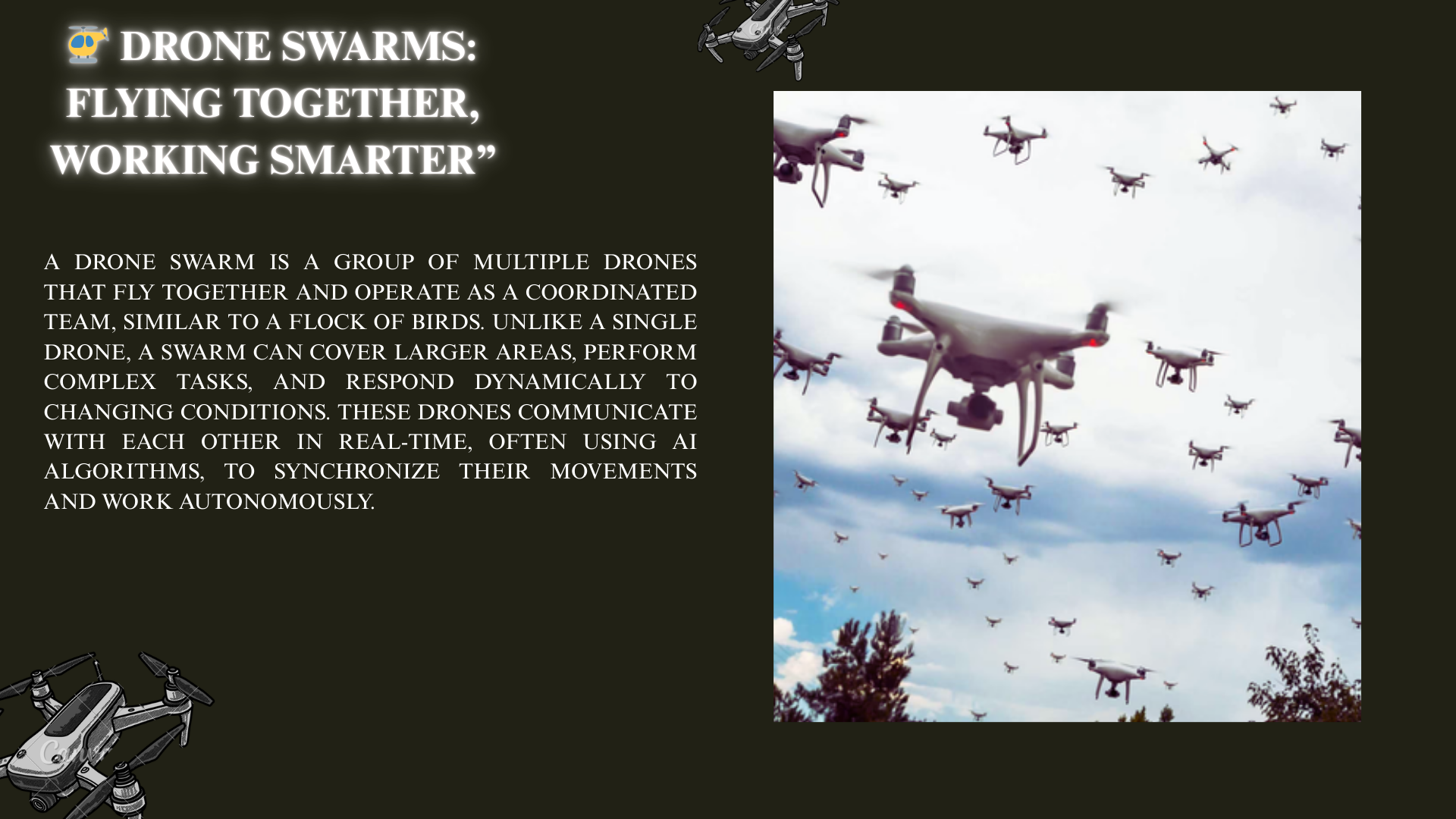
A drone swarm is a group of drones that operate together in a coordinated manner, sharing information and adjusting their actions in real time. Instead of relying on a single controller, swarm drones use AI algorithms 🤖 to communicate with each other and make decisions collectively.
This allows them to:
Maintain formation ✈️
Avoid collisions 🚧
Complete missions autonomously 🧭
How Drone Swarms Work ⚙️
Drone swarms rely on a combination of technologies to function effectively:
Communication Systems 📡
Drones exchange data like position, speed, and environment continuously
AI & Algorithms 🤖
Control coordination, path planning, and decision-making
Sensors & Cameras 📷
Help drones detect obstacles and understand surroundings
Decentralized Control 🧭
Each drone can make decisions while following the swarm’s overall mission
This system allows drones to act like a single intelligent unit made of multiple flying devices.
Applications of Drone Swarms 🚀
Drone swarms are used in many industries:
Surveillance & Security 🛰️
Monitoring borders, cities, and large industrial areas
Search & Rescue 🚨
Covering large areas quickly during emergencies
Agriculture 🌾
Crop monitoring, spraying fertilizers, and field mapping
Infrastructure Inspection 🏗️
Inspecting pipelines, bridges, and power lines efficiently
Military & Defense 🪖
Coordinated missions for reconnaissance and tactical operations
Advantages of Drone Swarms ✅
Wide Area Coverage 🌍
Multiple drones can scan large regions quickly
Faster Operations ⏱️
Tasks are completed in less time compared to single drones
Redundancy & Reliability 🛡️
If one drone fails, others continue the mission
Scalability 📈
Swarms can be small or large depending on the task
Autonomous Operation 🤖
Reduced need for human control
Challenges & Limitations ⚠️
Complex Coordination 🔄
Managing multiple drones requires advanced algorithms
Communication Issues 📡
Signal loss can affect swarm performance
High Cost 💰
Advanced hardware and AI systems are expensive
Security Risks 🔐
Swarms can be vulnerable to hacking or misuse
The Future of Drone Swarms 🔮
Drone swarms are expected to play a major role in the future of technology. With improvements in AI 🤖, 5G/6G connectivity 📶, and edge computing 💻, swarms will become more intelligent, faster, and more reliable.
In the future, we may see:
Fully autonomous delivery networks 📦
Smart cities monitored by drone swarms 🌆
Large-scale environmental monitoring 🌱
Advanced defense systems 🛡️
Conclusion 📝
Drone swarms 🐦 represent a powerful shift from single drones to coordinated, intelligent aerial systems. By combining AI 🤖, communication 📡, and automation, these swarms can perform tasks faster, safer, and more efficiently. As technology continues to evolve, drone swarms will become a key part of industries like agriculture 🌾, logistics 📦, security 🛰️, and disaster management 🚨